Advertising gets more expensive from October. Inflation has nothing to do with it.
Over the next few weeks, the same thing will happen that happens every year: online advertising will get more expensive. Slowly at first, sharply around Black Friday, and it stays that way until just before Christmas. Most people take it the way they take the weather.
But it isn’t weather. It’s a mechanism. And the same mechanism explains why, over the last two years, click prices rose more than three times as fast as consumer prices.
In short: ad placements don’t have a fixed price. They’re auctioned, fresh every time someone opens a page. What a click costs depends on how many advertisers are bidding for the same people and what a contact is worth to them — not on inflation. And because people and advertising money are concentrating on fewer and fewer platforms, the bidding in those auctions keeps getting tighter.
The numbers: faster than inflation — but not because of it
The most reliable figures on this aren’t in industry studies. They’re in the platforms’ own financial reports. Every year, Alphabet discloses how Google’s cost per click has changed, and Meta discloses its average price per ad:
| Change year on year | 2023 | 2024 | 2025 | 2026 |
|---|---|---|---|---|
| Google: cost per click | +1% | +7% | +7% | +4% (first half) |
| Meta: price per ad | −9% | +10% | +9% | +12% (Q2) |
| Inflation in Germany | 5.9% | 2.2% | 2.2% | 2.9% (August) |
Sources: Alphabet annual reports for 2023, 2024 and 2025 and quarterly report Q2 2026; Meta results for 2023, 2024, 2025 and Q2 2026; Destatis for 2025 and August 2026.
In 2024 and 2025, ad prices on both platforms rose more than three times as fast as consumer prices. That matches the common experience that advertising gets a little more expensive every year.
The interesting column, though, is 2023. Inflation stood at 5.9% — and Google’s click prices rose by 1%, while Meta’s prices actually fell by 9%. If you think of ad prices as a form of inflation, that year makes no sense. Meta delivered 28% more ads in 2023 than the year before. The supply of ad placements grew faster than demand, so the price fell.
One caveat belongs here: these are global averages. Meta itself says its average is held down by strong growth on surfaces and in regions where advertising is cheaper. The increase in individual markets can therefore be higher than the average.
An ad placement doesn’t have a price. It’s auctioned.
When you open a feed or search for something, an auction runs in the background: within milliseconds it decides which ad you see and what it costs. That happens billions of times a day, fresh each time.
That’s why inflation doesn’t appear in this calculation. An ad placement has no production costs that could rise. It costs whatever the other bidders are willing to pay for the same person. In its annual report, Google lists among the factors that move its numbers “advertiser competition for keywords” and “seasonal fluctuations in internet usage, advertising expenditures, and underlying business trends, such as traditional retail seasonality.”
It also means the price isn’t the same for everyone. On Meta, the highest bid doesn’t simply win — Meta weighs it against how well the ad is expected to perform and against its quality (Meta Business Help Center: About ad auctions). An ad that people actually find interesting can beat a higher bid.
Three reasons the auction keeps getting tighter
If the price comes from the auction, the real question is: why do advertisers bid more, and more often, every year? Three reasons work together.
1. Advertising works better — and that gets priced in
It sounds paradoxical, but it’s the strongest driver. The platforms keep getting better at showing an ad to exactly the people who respond to it. That makes every contact worth more — and in an auction, advertisers bid that extra value away from one another.
For the second quarter of 2026, Meta names “ad performance gains” as the first reason for its 12% price increase (earnings call Q2 2026). Part of what better technology adds in effectiveness ends up in the price.
2. The people are on a handful of platforms
3.6 billion people use at least one of Meta’s apps every day; Instagram alone has 2 billion daily users. Where the people are, the advertising money follows — and with growing force.
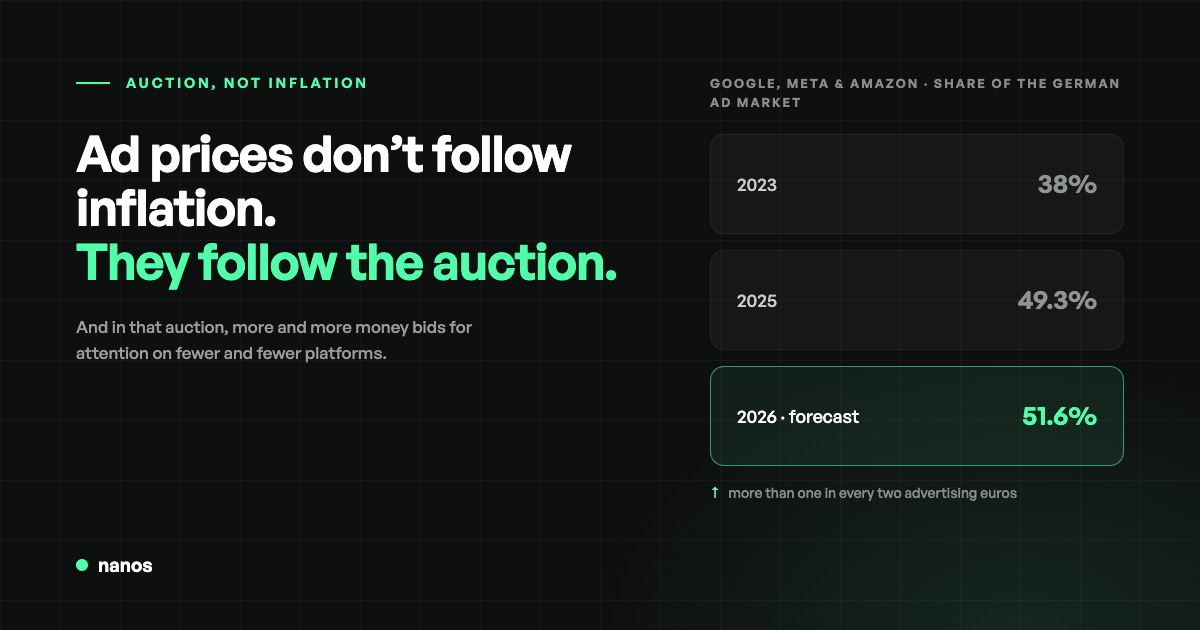
In Germany, according to Die Mediaagenturen, the association of German media agencies, Google, Meta and Amazon took 38% of the entire net advertising market in 2023. In 2025 it was 49.3% of €30.9 billion. For 2026, the association expects them to take more than one in every two advertising euros for the first time: 51.6%. Globally, excluding China, the three account for 57.6% according to WPP Media.
For the price, what matters is which side grows faster. Supply does grow: Meta delivered 14% more ads in the second quarter than a year earlier. But the money grows faster — Meta’s advertising revenue rose 27%. The difference is the price.
3. Anyone can bid
A bakery can’t afford a TV spot before the evening news. It can afford an ad in the same feed as a car manufacturer — for a few euros a day. Self-service and automation, tools like Nanos included, have opened the door for small businesses to exactly the auctions that used to be the preserve of big budgets.
That’s good for the bakery. It also means more bidders in the same auctions.
Once a year you can see the mechanism: the fourth quarter
In autumn a fourth reason joins the other three, and this one is purely seasonal. Ahead of Black Friday and Christmas, retailers in particular raise their budgets, and substantially. The number of people scrolling and searching in those weeks doesn’t grow at the same rate.
How hard that hits you depends on where you advertise:
- In feeds such as Facebook and Instagram, you compete with everyone who wants to reach the same people as you — whatever their industry. In November, the hairdresser round the corner is bidding against a Black Friday retailer for the same spot in the same feed.
- On Google Search, you bid on a search term. The online retailer isn’t bidding on “hairdresser Hanau”. The pressure there comes only from those advertising on exactly your terms.
So it pays to compare fourth-quarter prices with the same period last year rather than with spring — and to plan early instead of cutting in a panic in November.
Who profits when prices rise
Put two figures from Meta’s latest quarter side by side: 14% more ads delivered, 12% higher price per ad. Together that makes 27% more advertising revenue. Every percentage point the price goes up lands with the auctioneer.
That’s not an accusation. It’s the business model. The platforms own the ad placements, run the auction, build the automation that bids on your behalf, and decide its default settings. They are seller, auction house and adviser in one. Their tools are good — but they come from the side that earns on every euro spent.
This is the difference Nanos is built on. We aren’t Meta and we aren’t Google. We don’t sell ad placements — we buy them on your behalf.
We don’t earn anything from a click getting more expensive. Our optimisation works at the other end. In a traffic campaign, the most common kind, the AI checks every day which of your ads bring the most clicks for your money and gives them the largest share of the budget. If Google is currently doing better than Facebook, the money moves there — and vice versa. And if you can measure on your website what happens after the click, you can also launch conversion campaigns through Nanos, which optimise for enquiries or purchases instead of clicks.
And our business has one simple condition: if we don’t get more out of your budget than you’d get by going directly to Meta or Google, you won’t book a second time. The trust a company like ours depends on isn’t given for free. It has to be earned again with every campaign.
What this means for you
If you run your own advertising, there’s no way around these platforms — your customers are there, and that won’t change any time soon. But you don’t have to accept the price of any single platform. Several networks mean several auctions: if one of them gets crowded in November, the budget can move elsewhere. And on a small budget the usual rule applies: at the minimum of €5 per day per network that we suggest, one or two clicks a day is often the ceiling. Individual days tell you little — judge the trend over weeks.
If you’re a white-label partner, whether publisher or agency, the German figures deserve a second look. The eleven percentage points that Google, Meta and Amazon gained between 2023 and 2025 are missing from other media — newspapers and free weeklies, radio, television. With white label, you sell access to exactly these platforms under your own brand, rather than selling against them.
Two things help with that right now. First, your sales team will be asked in November why the same budget buys fewer clicks than it did in spring. The answer above holds up, because it’s built on the platforms’ own figures. Second, independence is your argument too: you sell as the local partner, and the optimisation behind it sits on your clients’ side — not on the auctioneer’s.
What to do with all this
Plan the fourth quarter now, not in November. Prices rise at the same time every year. The only surprising thing about it is how often it still comes as a surprise.
Compare prices with last year, not with spring. A November click that costs more than an April click isn’t a finding.
Don’t put everything on one platform. Several auctions give your budget room to move when one of them gets crowded.
Don’t look only at the click price. Whether advertising pays off is decided after the click — by the enquiries, calls and visits that come out of it. If you can measure that on your website, your campaign can optimise for it directly. And if you want to know whether your campaign is paying off, ad attribution is the place to start.
Ad prices aren’t weather. They’re the outcome of an auction in which, every year, more money bids for attention on a handful of platforms — and in the fourth quarter, more than at any other time. That direction isn’t going to change any time soon.
What you can change is who sits at the table for you. In a market where the seller of the ad placements also runs the auction and builds the tools you bid with, it’s worth having someone there who is on one side only: yours.
Frequently Asked Questions
- Because ad placements are auctioned, and in the fourth quarter far more advertisers are bidding. Ahead of Black Friday and Christmas, retailers in particular raise their budgets, while the number of people scrolling and searching in those weeks doesn't grow at the same rate. So the price at which the auction clears goes up. Google's own annual report lists retail seasonality explicitly as a factor.
- Over the last two years, yes — clearly. In 2025, Google's cost per click rose 7% and Meta's average price per ad rose 9%, against 2.2% inflation in Germany. In 2023 it was the other way round: with inflation at 5.9%, Google's click prices rose just 1% and Meta's prices actually fell 9%. Ad prices don't follow inflation. They follow supply and demand in the auction.
- Not necessarily. On Google Search, you bid on a search term. If you advertise on “hairdresser Hanau”, you compete with the others bidding on exactly that term — not with an online retailer's Black Friday offer. In feeds such as Facebook and Instagram it's different: there you compete with everyone who wants to reach the same people, whatever their industry.
- Not as a blanket rule. If your customers buy in autumn and in the run-up to Christmas, that's the wrong moment to disappear. If they don't, look at how your own costs develop — over weeks, not individual days. With Nanos, the AI already shifts your budget between networks every day, towards wherever it's currently doing better.
- No. We aren't Meta and we aren't Google — we don't sell ad placements and we don't run an auction. We buy on your behalf, and our optimisation works at the other end: getting as much as possible out of your budget. In the long run our business only works if you book again — and you'll only do that if it paid off for you.
- Because that's where the people are: 3.6 billion people use at least one of Meta's apps every day. The advertising money follows them. In Germany, Google, Meta and Amazon took 38% of the entire net advertising market in 2023 and 49.3% in 2025. For 2026, the German media agency association Die Mediaagenturen expects them to take more than one in every two advertising euros for the first time.